
From Partners to Parents: Navigating Relationship Changes After Baby
One of Life’s Biggest Transitions
Adding a baby to the family can be one of the most exciting times in a couple’s relationship. Babies are cute, cuddly, and they can be a real reminder of what love feels like. It is also one of the biggest transitions I think any person (and couple) goes through in their lives. And what do we know about transitions? We know that transitions are typically challenging periods of adjustment. Stress, anxiety, and overwhelm can all increase as we navigate uncertain waters, and welcoming a new baby brings a profound transformation to the relationship itself.
All of this is okay and, even dare I say… normal. But the problem is that everyone is so fixated on the happy part of adding a new addition to the family. And yes, be happy!! I will never tell anyone not to be happy about their baby. But… we need to also create space to acknowledge the challenges couples face during this huge transition period. Because leaving the not so happy parts of the transition in the dark only fosters confusion, loneliness, shame, and guilt, which contributes to a more difficult time adapting to a new season of life.
You can be completely in love with your baby and still struggle with the transition to being a parent while also navigating your role as a partner. Those two things can exist at the same time, and I think more often than not, they do.
You Aren’t Just Adding A Baby… You’re Changing Your Relationship
It isn’t just the two of you plus a baby… it’s the three of you, and that changes things.
**I want to take a second to make an important point: Change is okay, and change can be good, but it can also be scary and uncertain for most people (myself included). When I talk about change throughout this piece, I want to challenge you to think about change in a more dynamic way. We can acknowledge that change is scary and uncertain while also making room for the possibility that it can be wonderful and beautiful. Because as always… two things can be true at once.
The transition into parenthood isn’t just about adding another person to an existing relationship. It changes the existing relationship itself, transforming it into something new. Expecting that your relationship will look exactly the same, except with a baby added to it, is an expectation that can set you up for failure.
Does that mean you shouldn’t experience the joy, happiness, and love that comes with welcoming that cute little baby? Absolutely not. It means two things can be true at the same time. We can be over the moon excited about that new little bundle of joy while also acknowledging the disruption.
Your routines change.
Your priorities change.
Your responsibilities change.
Your needs change.
Your relationship with your partner changes.
You change.
Some of these changes are temporary, but some of them are more long term and even permanent. You hear so much about, “returning to normal” after a baby… but what if the goal isn’t to get back to “normal”? What if the goal is to figure out what the new normal looks like now that the family has expanded? Because more often than not, no couple is getting 100% back to the way it was before welcoming their baby (and that’s okay, but we need to manage the expectation).
Maybe the goal isn't to go back. Maybe the goal is to figure out where you're going next.
What Changes When You Become Parents?
Before Baby comes along, the relationship exists between two partners. It’s Partner 1 along with Partner 2, and that’s about it (sometimes there are some dogs or cats or birds or fish thrown in the mix as well, but for the most part, it’s just the couple).
After Baby arrives, a whole new family system is created that consists of Partner 1, Partner 2, and Baby.
Within this new family, two distinct and equally important relationships emerge:
The Parent Relationship: how you work together to care for and raise Baby.
The Couple Relationship: how you continue to connect as romantic partners.
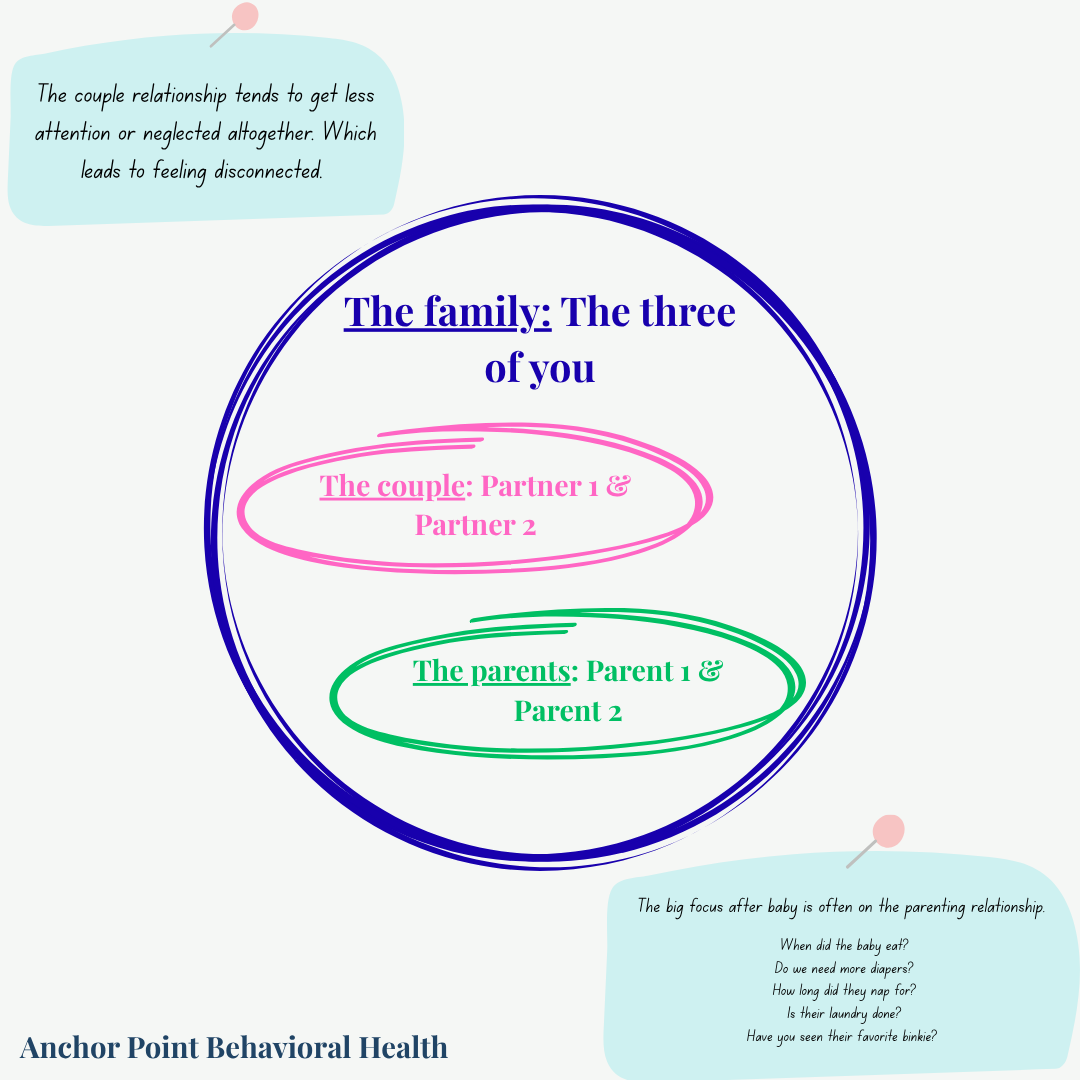
In most instances, The Parent Relationship becomes the star of the show after Baby arrives, which isn’t necessarily problematic. The challenge comes when The Couple Relationship becomes a total afterthought and ends up neglected. Because fostering The Parent Relationship doesn’t automatically mean you’re taking care of your romantic relationship. You can be the world’s best parenting team while simultaneously feeling disconnected from each other.
Both relationships deserve time and attention.
When Did We Start Feeling More Like Coworkers Than Romantic Partners?
Parenting is a lot of work… like, a lot of work. And coordination.
When The Parenting Relationship becomes the star of the show, how time is allocated and spent changes dramatically. Conversations become about logistics, free time turns into baby time, evenings are now when chores are caught up on, alone time becomes precious, date nights require a lot more planning, sex and intimacy may become more difficult to initiate or engage in… the list goes on.
Sometimes couples may go days without having a meaningful conversation which isn’t about caring for their new little one.
The Parent Relationship does need a lot of attention during this season of life. But, couples need to remember to make time for The Couple Relationship too, otherwise, they may start feeling like coworkers coordinating a project rather than lovers.
Connecting on a romantic level can be its own feat after welcoming a baby, and this is why I like to introduce the idea of microconnections.
Elaborate date nights may not be feasible at this point. You’re both tired, you’re both undergoing a huge adjustment and transformation, one of you may still be healing physically… it's a lot.
You don’t necessarily need a babysitter, a fancy dinner, an entire weekend away, or an elaborate expensive date night in order to feel connected. Connection can (and often does) happen in small day to day moments. Sitting together for 10 minutes after the baby goes to sleep, watching an episode of a show together, a hug that lasts a little longer than usual, sending each other a funny (or sentimental or encouraging) text, asking “how are you really doing?”, or sharing a cup of coffee together before starting the day.
The goal is intentionality.
What are the small, or micro, ways you and your partner can foster a sense of connection throughout the day?
“I Didn’t Realize How Much I Was Carrying”
The mental load each partner carries on a day to day basis can change after adding Baby to the mix. Some of the daily checklist items were to be expected and others showed up subtly and quietly until someone suddenly felt crushed by the pressure.
This is where it becomes so important to discuss expectations. And not just once, so many couples fall victim to the pitfall of discussing expectations once and then checking it off the list.
Talking about expectations needs to be an ongoing conversation. Much like a nice warm campfire where you need to continue throwing on wood to keep it going… expectations need continued attention because things change, unexpected circumstances arise, and people feel differently than they thought they would once Baby arrives.
Keeping this an ongoing discussion has long term benefits as well, because it can help combat resentment from developing down the line.
Because resentment isn’t always just about what our partner is or is not doing. It’s also…
“I thought you would know what I needed.”
“I thought this would be easier.”
“I thought I could handle this.”
“I thought you would notice.”
When the expectations conversation is ongoing, it creates space to adapt to things like someone becoming the default parent, unexpected aspects of physical and emotional recovery, feeling unseen or unsupported, less time together or energy for the relationship, and finding new ways to show up for one another during a time that is anything but predictable.
Even Super Parents Need Help
Often, new moms and dads enter parenthood with an invisible list of expectations, which may or may not be realistic. This can look like…
“I’ll be able to…”
Keep the house clean
Maintain my career
Cook dinner
Exercise
Keep up with my friends
Meal prep for the week
Maintain my relationship
Look put together each and every day
Sleep when the baby sleeps
All while enjoying every single moment, taking care of a new baby, and adjusting to one of life’s biggest changes.
The truth is, that list is often not realistic. I have not ever met one person who can do all of those things at the same time while caring for their new baby and adjusting to a totally new way of life… and that’s okay.
Just because it isn’t realistic to perfectly juggle all of those things, doesn’t mean you aren’t a Super Parent.
Even Wonder Woman needs help from the other members of the Justice League. So you can STILL be a Super Parent while needing help from your village or while letting some of those things on that long list fall to the wayside.
When these unrealistic expectations aren’t met, they can trigger feelings of inadequacy, disappointment, frustration, sadness, confusion, and fear. Not only do all of these emotions affect our individual wellbeing but they can have a huge impact on your relationship as well, which can be part of what makes the transition from partners to parents so difficult.
You may both be Super Parents but neither one of you possesses the power to mindread, which is why communication is so so important during this time period.
And, again, the communication needs to be ongoing, not just a one and done. Because expectations before getting pregnant, during pregnancy, and postpartum frequently change as we realize the realities of each stage of welcoming Baby to the family.
Try creating space to check in with one another and ask these questions:
What do we each expect from ourselves?
What do we expect from each other?
What feels realistic right now?
What can wait?
What does “help” actually look like?
What does each person need?
Having conversations around these questions continuously allows space for modification and fluidity, something that is much needed when adjusting to an expanding family.
Couples often get stuck when their initial expectations are hit with a hard dose of reality and there isn’t any space available to pivot. Creating even a small amount of time to regularly check in on the expectations as they evolve can make a world of a difference, help couples to stay connected, and lessen feelings of isolation and loneliness during a hectic time.
Your Partner’s Needs Still Exist… And So Do Yours
Both partners are in the process of a huge, life changing adjustment.
One may be recovering physically, experiencing hormonal changes, feeling touched out, navigating a new identity, and carrying more of the baby’s day to day care while the other may be returning to work, feeling disconnected from the baby, feeling helpless, feeling unsure how to support their partner, adjusting to financial or work pressures, or missing their old relationship.
Adjustment and transition in a relationship are not a competition for who has it harder. It’s a time to really see and understand one another’s experiences and needs, even if they differ from one another.
An example I see so often in my clinical work is one partner being touched out, often the one who takes on a majority of the caregiving.
Sometimes one partner wants physical closeness at the exact moment the other partner feels like they cannot tolerate one more person touching them after having a baby or infant clinging to them all day.
That doesn’t necessarily mean the touched out partner is saying, “I don’t want you.”
It may mean, “My body has been needed all day, and I need a little bit of space before I can be physically connected again”.
This is a hugely important distinction for couples. Without an ongoing discussion about expectations, it very easily turns into a slippery slope of misunderstanding and feelings of rejection.
You Can Only Plan So Much
Listen, I love a nice, beautifully laid out plan. But if there is one thing I’ve learned from becoming a parent myself, it’s that the only thing you can truly expect from a baby is the unexpected.
You can have the most perfect birth plan, feeding plan, sleep plan, childcare plan, work plan, household plan, etc… and then Baby arrives and says, “Absolutely not”.
When reality doesn’t match up to the plan, it isn’t uncommon for couples to accidentally fall into a pattern of blaming themselves or one another.
Practicing flexibility helps with transitions and especially with welcoming Baby by allowing space for adjustments as needed.
I’m not saying don’t make a plan for anything related to Baby, but try to think of the plan as written in sand instead of concrete
The Loss of Spontaneity and The Need For Intentionality
It’s completely okay and even relatively normal to experience a sense of loss or feelings of grief for the life and relationship that once was before Baby arrived.
Because some things will really change! And it’s totally okay to miss how things were before.
One of the biggest things I hear from couples is the loss of spontaneity and some of the little rituals in their relationship after welcoming Baby.
Maybe it’s coffee in bed first thing in the morning. Maybe it’s deciding at the last minute to go somewhere. Maybe it’s staying up late talking or heading out for an unplanned date night.
These little things can be easy to take for granted when they are readily available. Once they become less likely, their absence can feel surprisingly significant.
It is a loss, and it’s healthy to recognize any grief surrounding it. It does, however, pave the way for something new: intention.
With spontaneity becoming less likely, it is important for couples to shift into being more intentional about the time and activities they dedicate to themselves as a couple.
I know, I know, it doesn’t sound as fun as the spontaneous road trip down the shore or the last minute date night but, and stay with me here… what if we thought of that intention as a pathway to more appreciation?
Time together is now more coveted, with more intention, and less spontaneity, there is room for small things that happen in the relationship to be more noticed, more appreciated, and feel more special. The way couples appreciate time together shifts and it feels different. But remember, different doesn’t automatically mean bad.
Small moments of connection can feel more meaningful because they aren’t guaranteed now and maybe they’re even less likely to be taken for granted the way they were pre-baby.
Becoming parents may and likely will change how you spend time together and connect but it can also change how you experience and value time together, which can add a whole new level of depth to the relationship.
So maybe instead of connection looking like coffee in bed, spontaneous plans, staying up late talking, going out whenever you want, or unplanned date nights, it looks like:
Ten minutes together after bedtime.
Sharing coffee while the baby plays independently.
Planning a date night several weeks in advance (how exciting is it to have something to look forward to?).
Sitting together while one person feeds the baby.
Or a quiet morning together before the baby is up for the day.
Neither version of connection is wrong or right, they are simply different.
The goal isn’t to recreate what connection looked like before becoming parents. The goal is to discover how to continue nurturing your relationship, growing together as parents and partners, and finding new ways to connect with one another while you navigate a completely new landscape and family dynamic.
If we can remove the association of intention with decreased passion and romance, we can see it for what it truly is: a chance to connect in a new way, to feel more prioritized, and to foster and grow the relationship into something new.
And please know… you can be completely obsessed with your baby and deeply grateful for the family you've created while still missing the ease, attention, spontaneity, and connection you had before becoming parents. Missing those things doesn't mean you want your old life back or regret having your baby. It means you're human, and you're adjusting to a very different season of life. It’s okay and totally normal to miss the comforts of what was once very familiar during a time of significant growth and change.
Stop Trying To Get Back To Where You Were
“You’ll get back to normal”.
How many times have all my new or even seasoned parents heard that line?
The truth is, you likely won’t go back to normal. You will create a new normal.
And that is an important distinction.
If you are constantly chasing after what your relationship was like before the baby arrived, you will likely find yourself disappointed and frustrated.
Because you are now different, your partner is different, your family structure is different, your relationship has changed, your priorities have changed. But that doesn’t mean the relationship is doomed to become worse over time.
It means you are building something new. You aren’t trying to reinstall the old version of your relationship, you’re learning how to use the newest version.
We need to stop struggling to return to “normal” when really what we need to do is redefine what normal is moving forward.
The Power of Microconnections
Try a Feelings Check.
Yep, you read that right: A Feelings Check.
In my own relationship, after we welcomed our son into our lives, my husband and I started asking each other a simple question:
“Feelings check?”
It didn’t require a long conversation or a perfectly quiet house. It didn’t require time exclusively to ourselves or a scheduled time to talk. It was just a way of asking: How are you doing right now? Do I need to know anything?
That’s what worked for us.
I encourage you to either use it or make it your own, put your own spin on it. Your relationship is uniquely yours and just because that worked for us, doesn’t mean it will or has to work for you.
Find what feels good for you and your partner and make it part of your own rhythm.
What are you feeling?
What’s been hard today?
What do you need from me?
Do you need support, space, or connection?
Is there something you’re carrying that I don’t know about?
A microconnection doesn’t need to solve a big, giant problem. A microconnection won’t magically fix any disconnection that may be happening.
What it will do is remind one another:
“We’re still here”
“We’re still a team”,
“We’re still partners”.
And microconnections have a way of adding up! Imagine even one small microconnection per day, that’s a minimum of 7 per week, 30 per month, and 365 per year.
That’s significant.
It isn’t always the big moments that connect us to our partners, it’s actually more often than not the small day to day reminders that we wake up and choose one another each and every day.
What’s something small that fosters a sense of connection to your partner? What’s something small that helps your partner feel connected to you? If you don’t know, ask! Or explore by trying something new together during the week. Not everyone will feel connected with words, for some it’s touch, for others it’s an act of service or small gifts. Find what works well to help you and your partner feel connected and strengthen it.
Remember… You're Not Sliding Backwards, You’re Growing Forward
Becoming parents can change your relationship in ways you both expected and did not expect.
It’s okay to miss parts of your old life, parts of your old relationship, or even parts of yourself.
Grieving parts of your past life is a normal part of the transition process and it does not mean you are not grateful for the new family you’ve created together.
The goal isn’t to recreate the relationship you had with your partner before the baby arrived. It’s to intentionally update your relationship to the latest software model, one that makes room for the parents you’ve become while still making space for the partners you continue to be.
The newest version might look different. It might have some bugs. It might take some getting used to. But different doesn’t automatically mean worse.
Sometimes growing forward together can start with something as small as looking at each other after a long day and asking…
“Feelings check?” ♥️
When More Support Is Needed
Couples experience such a huge transition when they add a baby to their lives. In many cases, it is totally normal to experience a dip in relationship satisfaction, connection, or even disorientation as you try to find your new normal.
Sometimes, couples therapy can be another pillar of support during this huge period of transition and adjustment.
You don’t need to be in a relationship ending crisis to engage in couples therapy. A lot of times, couples therapy is another tool couples can use to continue to make their relationship stronger and strengthen their bond with one another.
Couples therapy can be especially helpful if couples feel they are experiencing difficult to manage relational changes such as persistent resentment, frequent conflict, feeling disconnected or lonely, significant intimacy concerns, consistently feeling unsupported, difficulty adjusting to new roles, or a perinatal mood / anxiety disorder which is affecting the relationship.
After all, couples therapy isn’t about determining who is right and who is wrong. It’s a space to build a deeper understanding of yourself, your partner, and your relationship. It’s a place to explore what each person needs and how you can work together to build the relationship you want moving forward.
If you’re interested in couples therapy at Anchor Point Behavioral Health, please feel free to complete the request form to schedule an initial, free consultation phone call with me. I’d be more than happy to talk with you about your concerns and your goals and what potential treatment would look like.
I am always honored to walk alongside my couples as they invite me into their lives to help them navigate big life moments and transitions.
And one final reminder, please remember that you never have to navigate rough waters alone.
With warmth & compassion,
Michelle at Anchor Point